THE DYSMUSIA FOUNDATION
SENDsational Support for Different WAIYS of Being
One of Three Sisters
DYSMUSICAL.ME • SCHOOL OF WELLSICIANS • THE DYSMUSIA FOUNDATION
WELL-BEINGS • SEND-LIVING • MUSIC-MAKING
DYSMUSIA FOUNDATION
OUR GIVE TO MUSIC MAKING
Awareness • Evidence • Research • Resources
Dysmusia is bigger than "Musical Dyslexia".
Our research began by asking a much bigger question:
In 2024 we commissioned YouGov to give us the BIG PICTURE across 2,130 GB adults.
The research has continued to develop.
In 2026, the Dysmusia Foundation brings that evidence, subsequent research and our developing thinking together — and GIVES it away.
What gets between people and making music — SEND or not?
OUR FIRST GIVE
THE GLOBAL SCALE OF DYSMUSIA
Musical Dyslexia — Or is it Dysmusia?
YouGov UK Special Edition Research Report
2,130 GB Adults — Quantitative Benchmark + Qualitative Voices
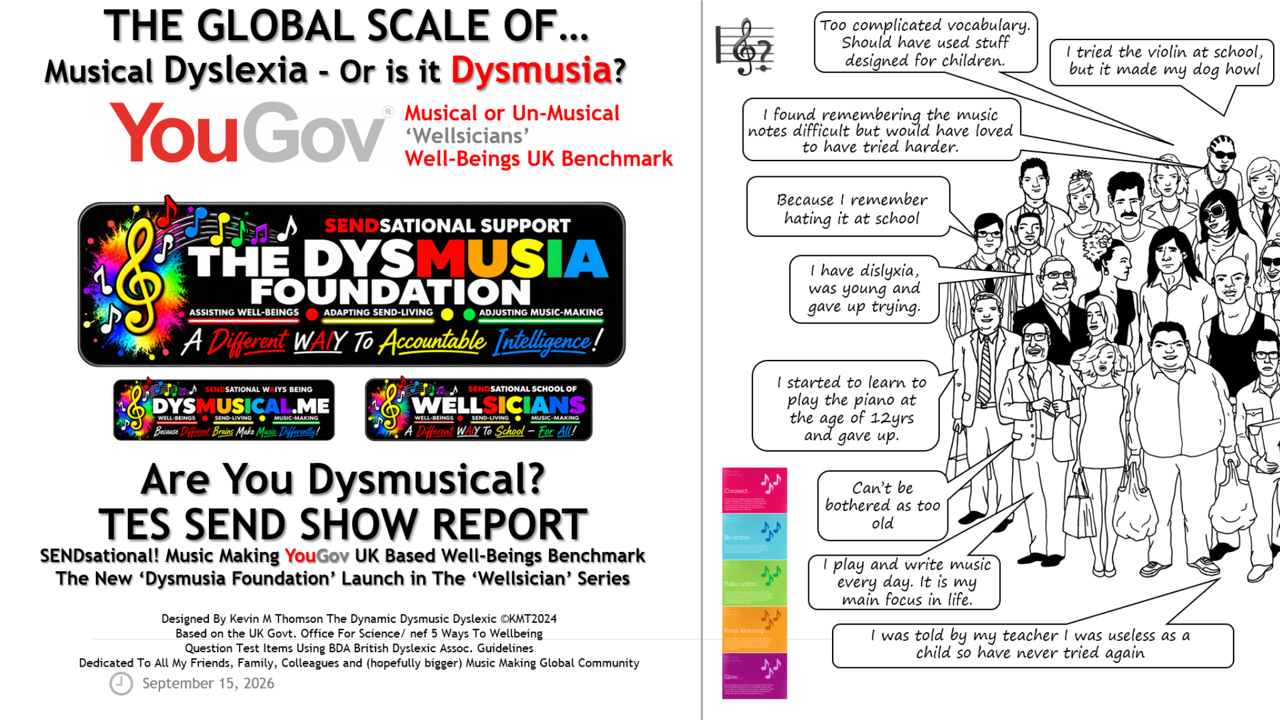
YouGov gave us the BIG PICTURE.
Wellsician gives ME my changing picture.
THE RESEARCH — THEN, NOW & NEXT
1. WHERE IT STARTED
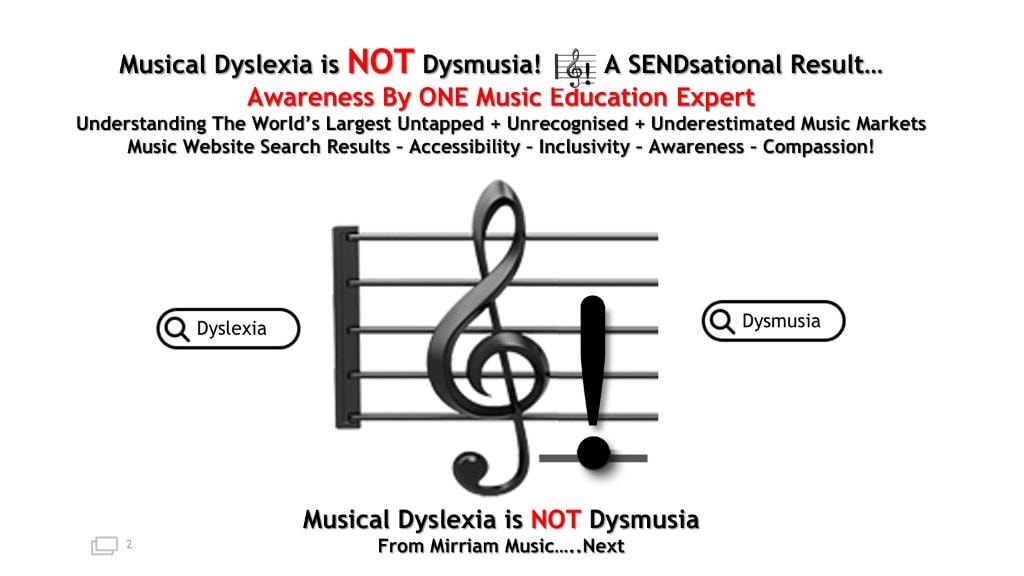
One search changed the question.
We knew about Dyslexia. We knew about "Musical Dyslexia". But search for Dysmusia and there was almost nothing.
Yet the difficulties people experience with music making clearly went far beyond reading notation.
So we started asking a bigger question:
What if Musical Dyslexia is NOT Dysmusia?
2. "NEVER HEARD OF IT!"
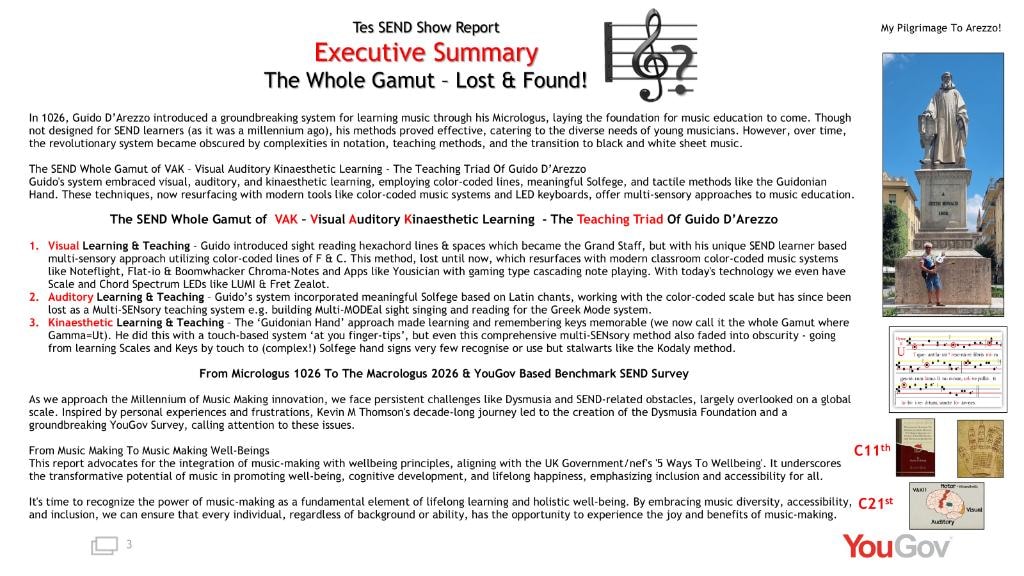
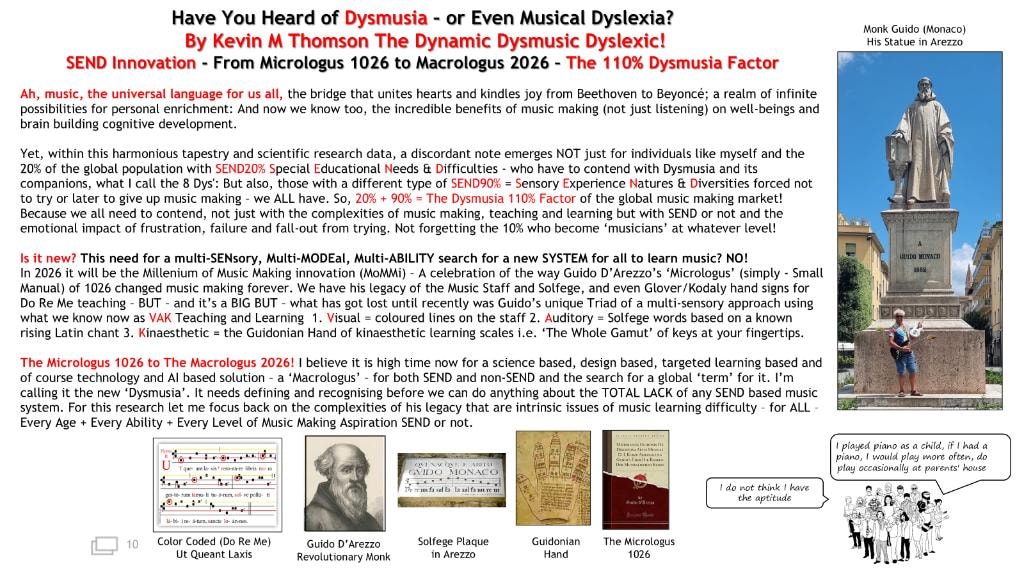
The search took us back 1,000 years.
In 1026, Guido D'Arezzo did much more than help change how music was written.
His approach brought together what today we would recognise as Visual, Auditory and Kinaesthetic ways of learning — colour, voice and touch.
Over the centuries, much of that multi-sensory Whole Gamut became separated, simplified or lost.
So another question emerged:
WHAT ARE THE DIFFERENT THINGS THAT CAN GET BETWEEN ME AND MAKING MUSIC?
2,130 GB ADULTS
We weren't the first to find the problem.
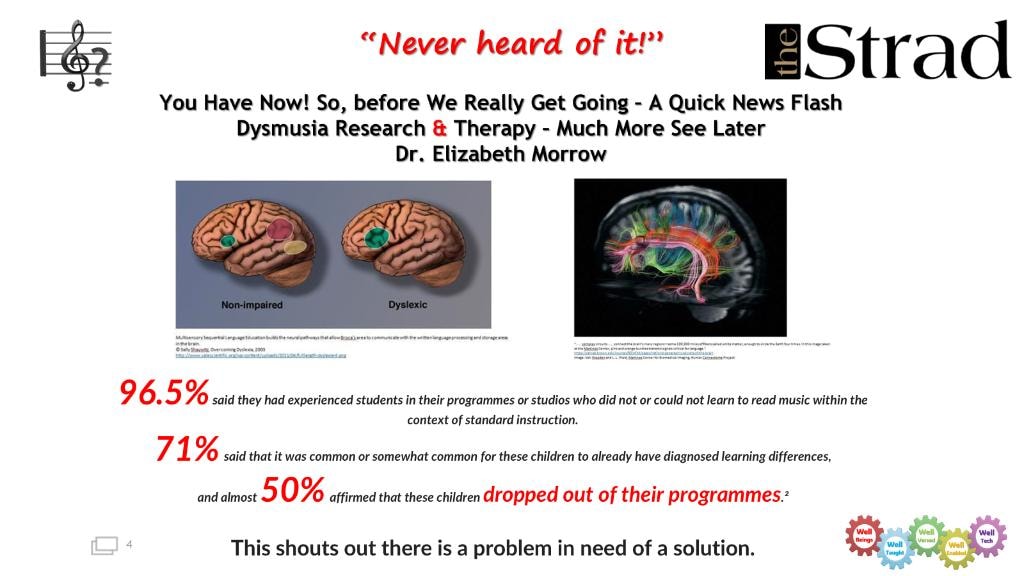
Dr Elizabeth Morrow had already asked string teachers what happened when students struggled to learn to read music through standard instruction.
The answers were startling.
96.5% had encountered students who did not or could not learn to read music through standard instruction.
71% said diagnosed learning differences were common or somewhat common among these children.
Almost 50% said these children dropped out.
So this was no longer simply our question.
THE PROBLEM WAS ALREADY THERE — BUT WHERE WAS THE BIG PICTURE?
4. DYSMUSIA ≠ MUSICAL DYSLEXIA
There was research. There were articles. There were teachers recognising that some learners were genuinely struggling.
But much of the discussion came back to one idea:
MUSICAL DYSLEXIA — DIFFICULTY READING MUSICAL NOTATION.
That mattered.
But our question was becoming wider.
What about rhythm, memory, sequencing, coordination, sensory processing, confidence, complexity, language — or simply being put off and giving up?
So we asked:
WHAT IF READING MUSIC IS ONLY ONE PART OF DYSMUSIA?
5. LISTEN TO THE PEOPLE
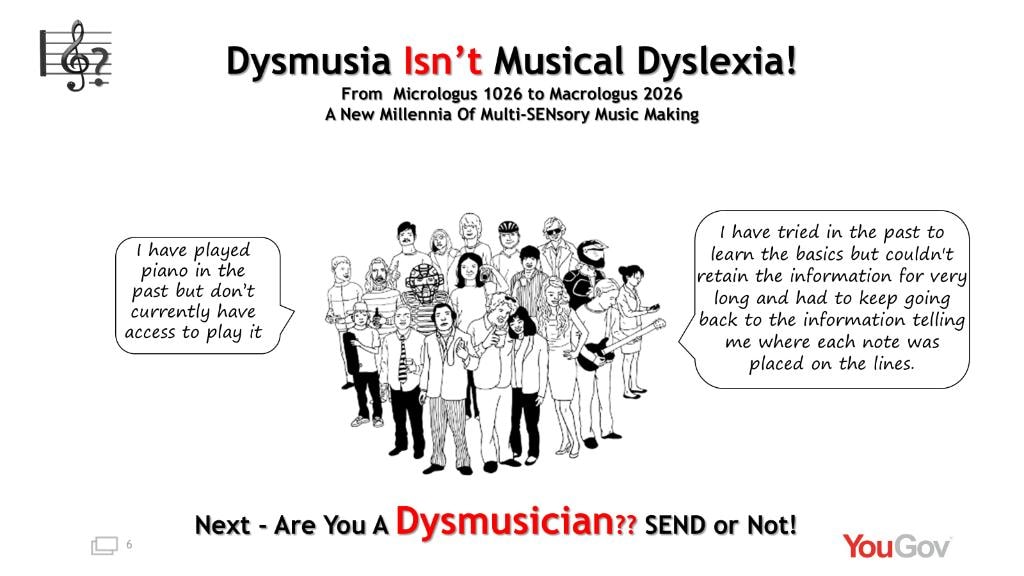
That wider question took us back to the people themselves.
The YouGov responses weren't just about reading music.
People talked about access. Memory. Retaining information. Learning the basics. Knowing where the notes were. Trying — and stopping.
Different people. Different experiences. Different difficulties.
So perhaps the question wasn't simply:
"Can you read music?"
It was:
WHAT GETS BETWEEN YOU AND MAKING MUSIC — SEND OR NOT?
6. WHO GETS TO BE CALLED MUSICAL?
Then came another challenge to the definition.
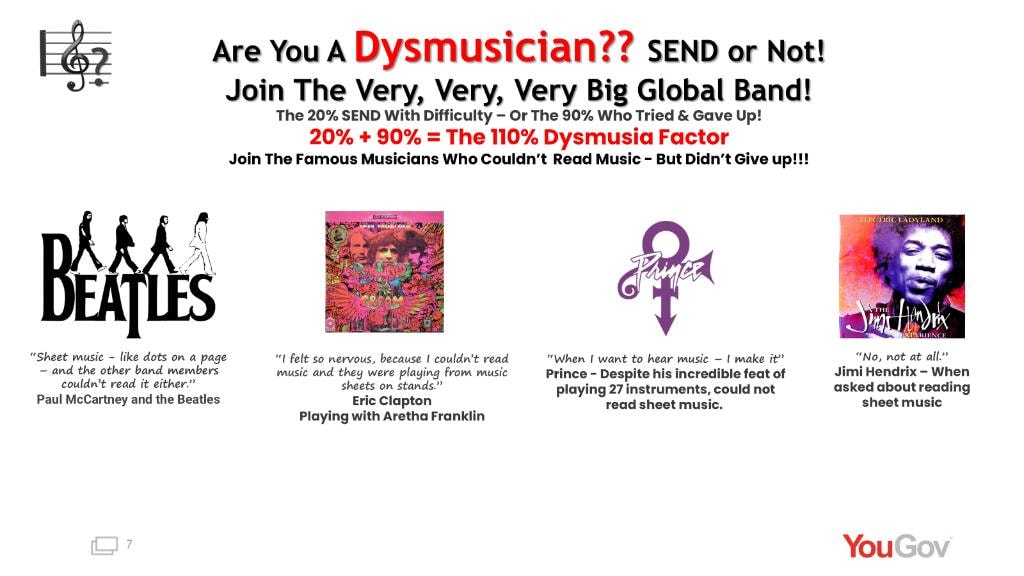
If difficulty reading conventional music notation makes someone "musically dyslexic", what do we make of extraordinary music makers who couldn't read music?
The Beatles. Eric Clapton. Prince. Jimi Hendrix.
Their stories expose an important distinction:
DIFFICULTY WITH THE SYSTEM IS NOT THE SAME AS LACK OF MUSICAL ABILITY.
So Dysmusia couldn't simply be about who CAN and CAN'T read the dots.
It had to ask a much bigger question:
WHAT HELPS PEOPLE KEEP MAKING MUSIC — AND WHAT MAKES THEM GIVE UP?
7. YOUGOV GAVE US THE BIG PICTURE
Questions and individual experiences could only take us so far.
We needed a benchmark.
So we commissioned YouGov to ask 2,130 GB adults about their experience of learning and making music — SEND and non-SEND.
The result was not a simple divide between people who "could" and "couldn't" make music.
It revealed a whole spectrum:
Those who learn, play, share, teach, read and enjoy music.
Those who want to do more.
And those who can't, don't, are scared, gave up, never tried or found it too difficult.
FOR THE FIRST TIME, WE COULD SEE THE BIG PICTURE.
8. FROM MUSIC MAKING TO BRAIN BUILDING
The research also raised another question.
If people are being excluded from music making, giving up, or never getting started, what might they be missing?
Not simply the pleasure of music.
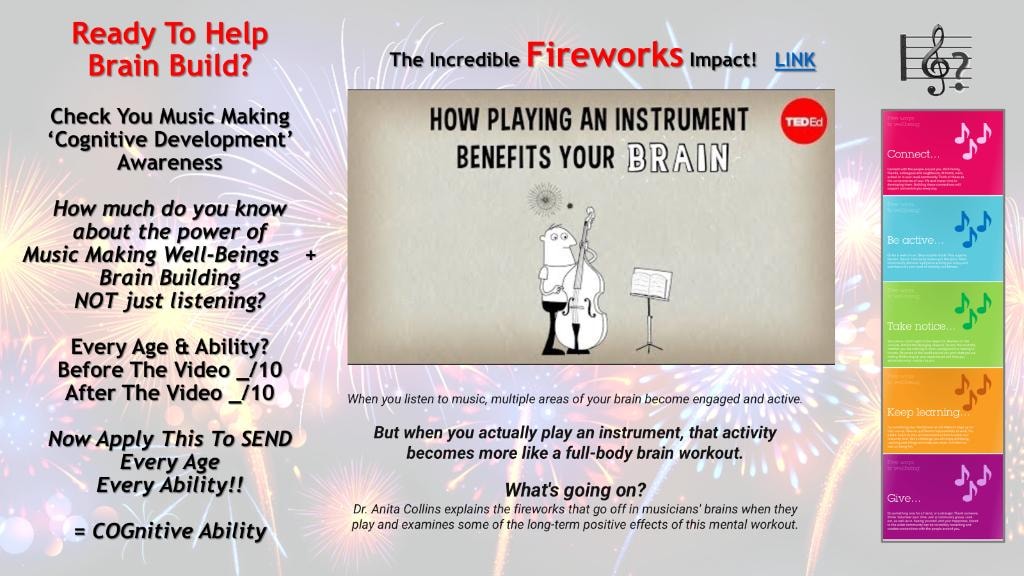
ACTIVE MUSIC MAKING engages the brain very differently from simply listening.
Dr Anita Collins' celebrated TED-Ed animation describes playing an instrument as something more like a "full-body brain workout" — with multiple areas of the brain working together.
That gave us another reason to look beyond musical difficulty alone:
WHAT MIGHT ACCESSIBLE MUSIC MAKING ADD TO WELL-BEING, LEARNING AND DEVELOPMENT?
9. FROM THE BIG PICTURE TO A BIGGER QUESTION
The YouGov BIG PICTURE brought the different strands together.
Music-making difficulty wasn't confined to SEND.
It wasn't confined to reading notation.
And it wasn't confined to people who had already been given a diagnosis or label.
People could struggle, become frustrated, stop, give up — or never really get started — for very different reasons.
For me, that made the research personal too.
My own Dysmusic Dyslexic experience, the YouGov voices and Guido D'Arezzo's thousand-year-old multi-sensory approach began pointing towards the same question:
DO WE NEED A BROADER WAY OF UNDERSTANDING DYSMUSIA — SEND OR NOT?
And if we do, perhaps we first need to understand what gets between each individual and their own music making.
10. WHAT DID "DYSMUSIA" ALREADY MEAN?
Before redefining Dysmusia, we needed to understand how the term was already being used.
Dr Elizabeth Morrow's work gave us an important starting point.
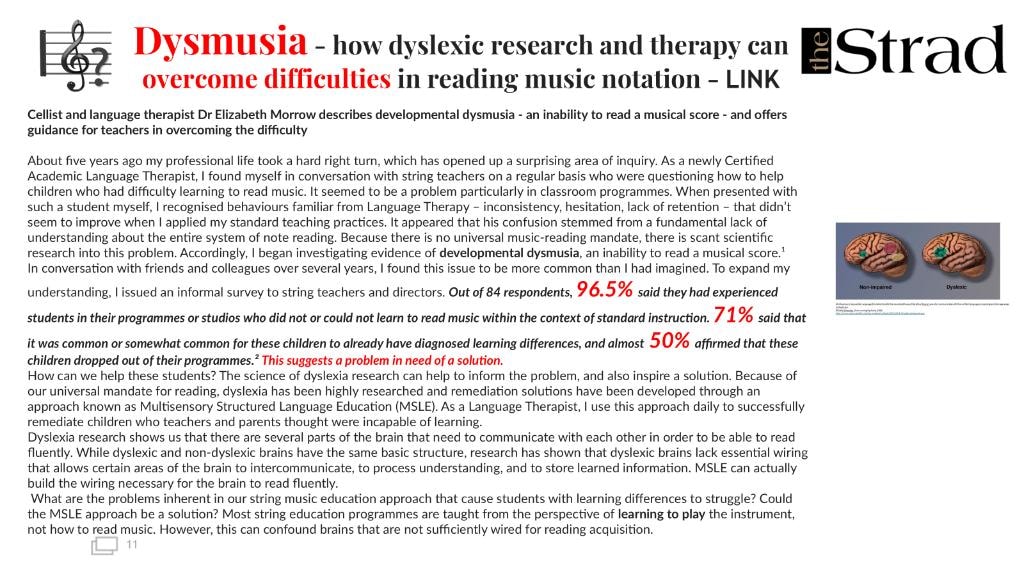
Her focus was developmental Dysmusia — difficulty or inability in learning to read a musical score — and what dyslexia research and multisensory approaches might teach music educators about overcoming that difficulty.
Her survey of 84 string teachers and directors also produced the striking findings we saw earlier:
96.5% had encountered students who did not or could not learn to read music through standard instruction.
71% said diagnosed learning differences were common or somewhat common among these children.
Almost 50% said these children dropped out.
This was powerful evidence.
But it also exposed the question at the heart of our research:
IF DYSMUSIA MEANS DIFFICULTY READING MUSIC, WHAT DO WE CALL ALL THE OTHER DIFFICULTIES THAT GET BETWEEN PEOPLE AND MUSIC MAKING?
11. THE FIRST DYSMUSIA PhD
Then we found something much more substantial.
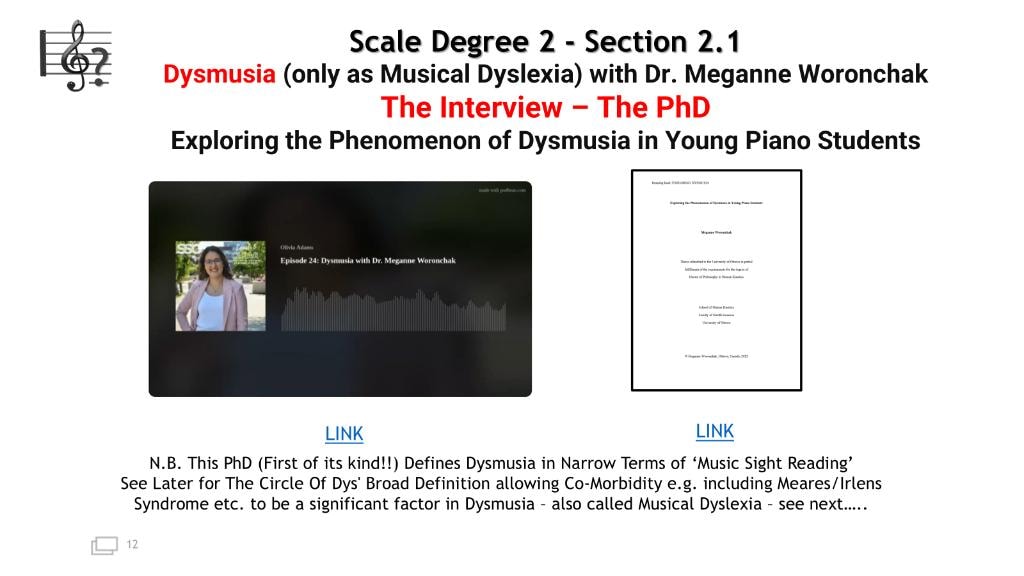
In 2022, Dr Meganne Woronchak completed her University of Ottawa PhD:
EXPLORING THE PHENOMENON OF DYSMUSIA IN YOUNG PIANO STUDENTS.
Her research explored Dysmusia in young musicians from both qualitative and quantitative perspectives — including music reading, music writing, audiation and associated cognitive, perceptual and motor difficulties.
Importantly, the work also considered whether Dysmusia might be an extension of Dyslexia OR a domain-specific phenomenon of its own.
This took the evidence considerably further.
But the central research territory was still music-reading difficulty.
Our YouGov work was beginning to ask a different — and broader — question:
WHAT IF DYSMUSIA IS NOT ONE DIFFICULTY, BUT THE INTERACTION OF DIFFERENT DIFFICULTIES AND DIFFERENCES THAT GET BETWEEN ME AND MAKING MUSIC?
12. DOES THE BRAIN READ MUSIC DIFFERENTLY?
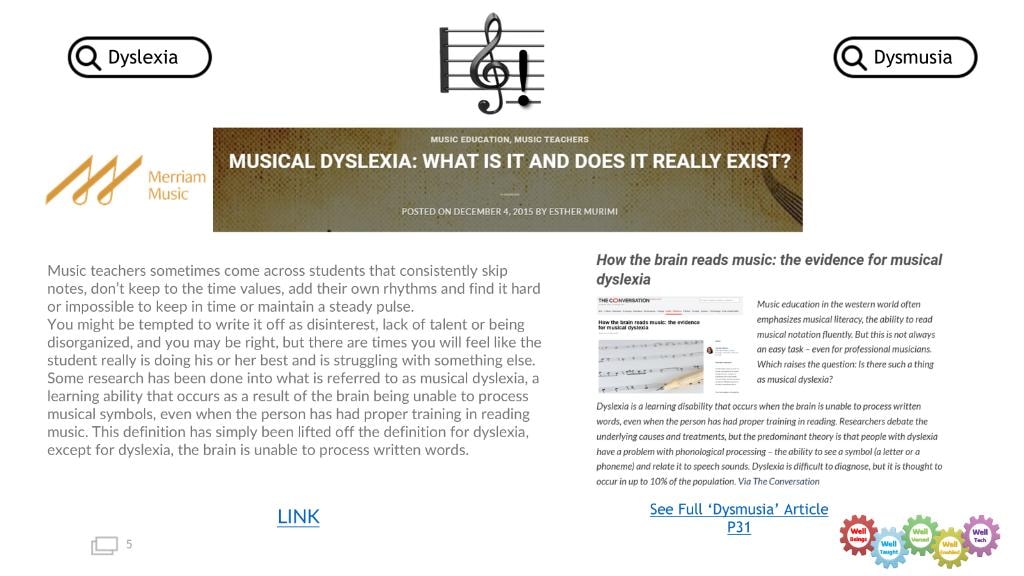
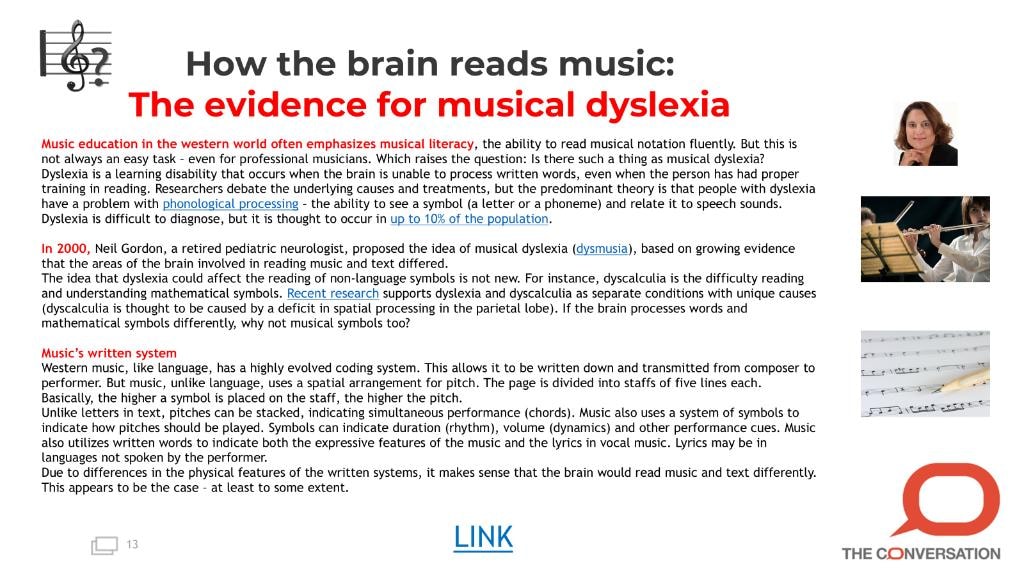
Another important piece of the puzzle came from music education researcher Jennifer Mishra.
In her 2015 article:
HOW THE BRAIN READS MUSIC: THE EVIDENCE FOR MUSICAL DYSLEXIA
she explored a deceptively simple question:
If the brain can process written words and mathematical symbols differently, why not musical symbols too?
Music reading is not the same task as reading text.
Pitch, rhythm, spatial position, symbols and other musical information can involve different processes — and research has even reported cases where particular aspects of music reading were impaired while others remained intact.
This strengthened the case for taking MUSIC-SPECIFIC DIFFICULTIES seriously.
But again, it brought us back to the same question:
IS DIFFICULTY READING MUSICAL NOTATION THE WHOLE OF DYSMUSIA — OR ONLY ONE PART OF IT?
13. THE DIFFICULTIES WERE ALREADY MULTIPLYING
The picture was getting wider.
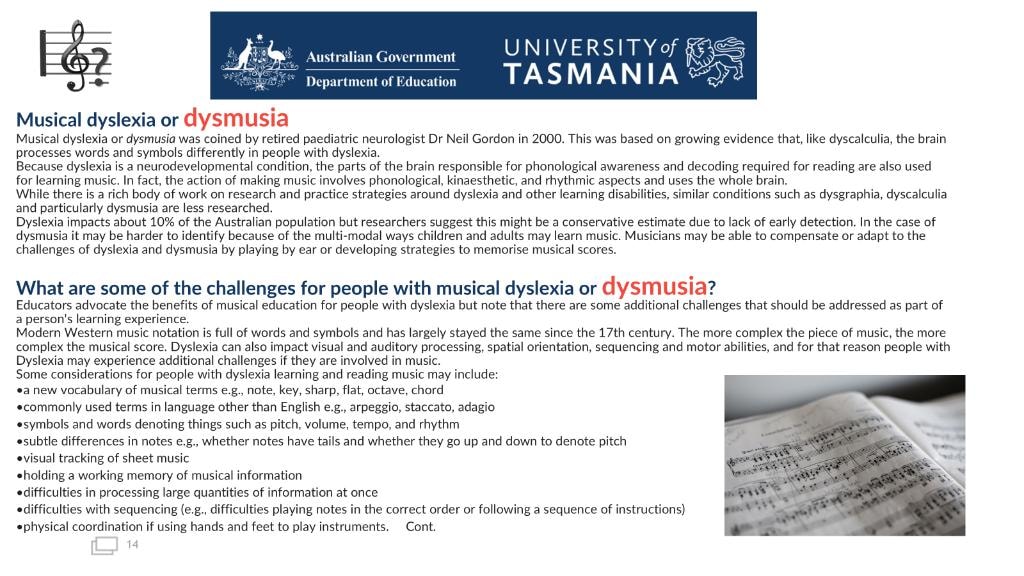
The Australian Disability Clearinghouse on Education and Training — ADCET — brings together guidance for tertiary education and disability practitioners.
Its Dysmusia resource describes "musical dyslexia or dysmusia" but then identifies a much broader range of challenges that can affect learning and making music.
These include:
- •musical vocabulary and symbols
- •visual tracking
- •working memory
- •processing large amounts of information
- •sequencing
- •visual and auditory processing
- •spatial orientation
- •physical coordination
Suddenly, the problem no longer looked like ONE difficulty with reading the notes.
It looked MULTI-MODAL.
And that raised another question:
IF ALL THESE DIFFERENT DIFFICULTIES CAN GET BETWEEN A PERSON AND MUSIC MAKING, WHY ARE WE STILL TRYING TO DESCRIBE DYSMUSIA AS SIMPLY "MUSICAL DYSLEXIA"?
14. WHY DOES ACCESS TO MUSIC MAKING MATTER?
By now our research had moved beyond one question:
"What makes music difficult?"
There was another:
WHAT MIGHT PEOPLE GAIN WHEN THEY ARE ABLE TO MAKE MUSIC?
That took us back to the UK Government Foresight / New Economics Foundation 5 Ways to Well-being:
CONNECT
BE ACTIVE
TAKE NOTICE
KEEP LEARNING
GIVE
We began mapping the reported benefits of active music making against those five everyday Ways to Well-being.
The possibilities reached across social connection, learning, creativity, achievement, emotional experience, physical activity and participation.
But this is an evolving evidence base — not a claim that every kind of music making produces every benefit for everybody.
That distinction matters.
Recent research continues to report psychological, social and physiological well-being outcomes from active music making, while also finding mixed results and important gaps in the evidence.
So our next research question became:
COULD THE 5 WAYS GIVE US A SIMPLE FRAMEWORK FOR EXPLORING MUSIC MAKING + WELL-BEING — FOR EVERY AGE AND ABILITY?
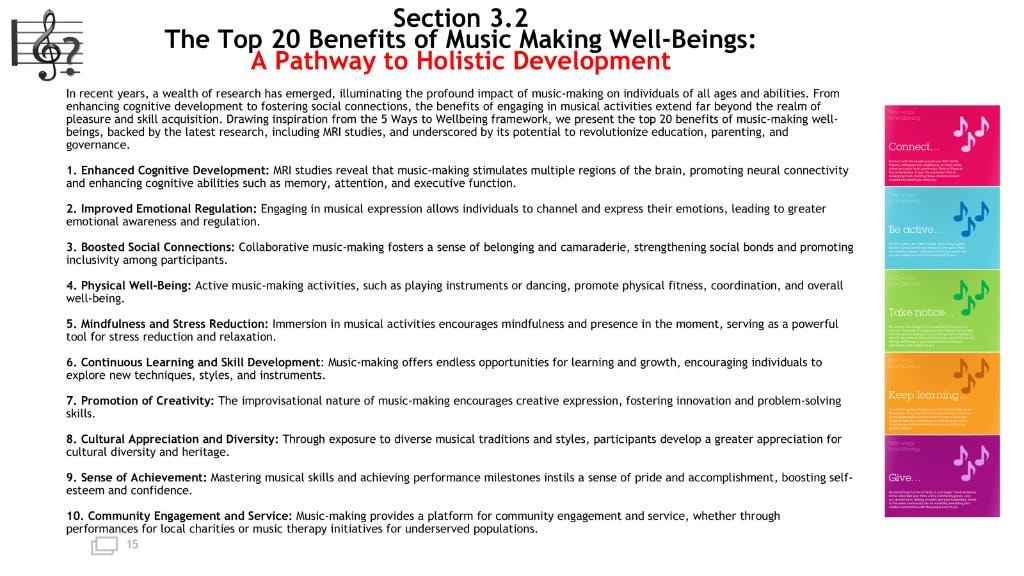
14A. FROM WELL-BEING TO WHOLE-PERSON DEVELOPMENT
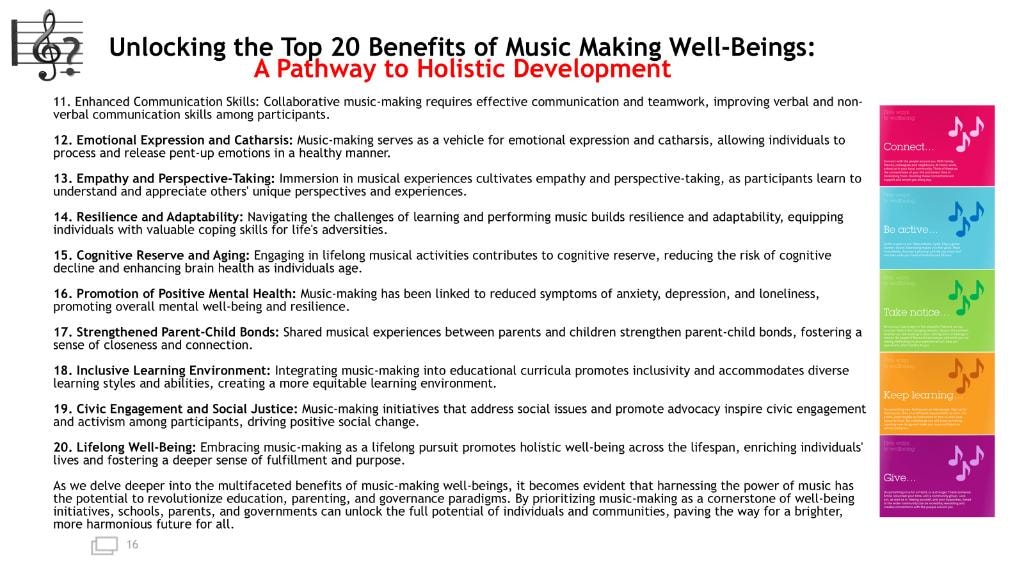
The second half of our original Top 20 widened the picture again.
Beyond learning, creativity and social connection, we began looking at areas such as communication, emotional expression, empathy, resilience, parent-child connection, inclusion, participation and lifelong well-being.
Taken together, the original Top 20 led us towards a much bigger idea:
MUSIC MAKING ISN'T ONLY ABOUT LEARNING MUSIC.
IT CAN TOUCH MANY DIFFERENT PARTS OF HOW WE CONNECT, DEVELOP, PARTICIPATE AND FEEL.
That is why the 5 Ways to Well-being became increasingly important to our work.
They gave us a simple human framework for asking a better question:
NOT "WHAT ARE THE 20 BENEFITS?"
BUT:
HOW DOES MY MUSIC MAKING HELP ME CONNECT • BE ACTIVE • TAKE NOTICE • KEEP LEARNING • GIVE?
RESEARCH UPDATE — 2026
Our original Top 20 was an exploratory synthesis of the potential benefits we were finding across the literature.
It should not be read as a claim that every one of these outcomes is produced by music making for every person.
The evidence continues to develop.
That is why the Dysmusia Foundation now treats the 5 Ways as a framework for exploring each person's changing experience — not as a promise of twenty guaranteed outcomes.
15. WHAT WAS MUSIC EDUCATION ALREADY SAYING?
Our own Top 20 wasn't the only attempt to describe why music education matters.
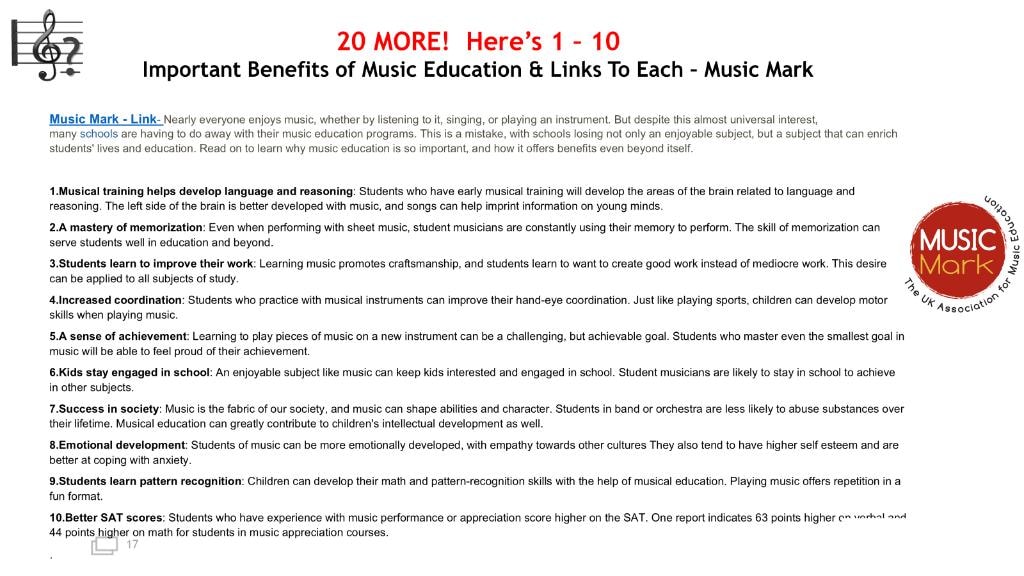
Music Mark — the UK Association for Music Education — also brought together 20 commonly cited benefits of music education, with links to supporting material.
Its first ten ranged across:
- •language and reasoning
- •memory
- •improving work
- •coordination
- •achievement
- •engagement in school
- •wider social development
- •emotional development
- •pattern recognition
- •educational attainment
There was an interesting overlap with the themes emerging in our own work.
But there is an important distinction:
A LIST OF POSSIBLE BENEFITS IS NOT THE SAME AS PROOF THAT EVERY BENEFIT WILL OCCUR FOR EVERY PERSON.
For the Dysmusia Foundation, that became increasingly important.
Rather than asking:
"WHAT DOES MUSIC DO FOR EVERYBODY?"
we were moving towards a much more personal question:
WHAT DOES MUSIC MAKING DO FOR ME?
15A. ANOTHER 10 — AND THE PATTERN CONTINUES
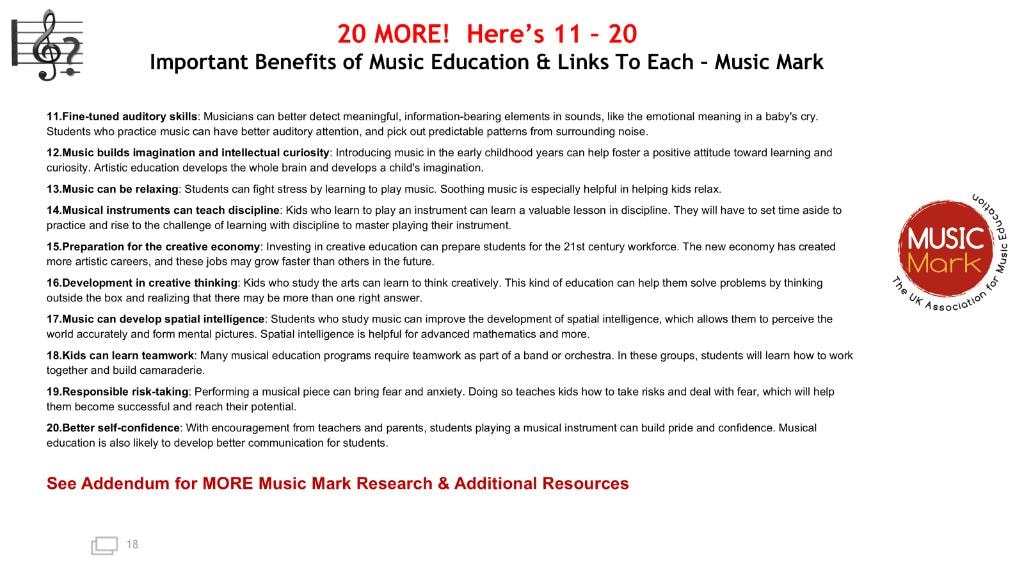
Music Mark's second ten widened the picture further.
Auditory skills. Curiosity. Relaxation. Discipline. Creativity. Spatial thinking. Teamwork. Risk-taking. Confidence.
Different claimed benefits — but again we could see themes that reached far beyond simply learning to play or read music.
And something interesting was happening.
The longer the lists became, the LESS useful a universal list seemed.
Forty possible benefits still couldn't answer the most important question:
WHICH ONES MATTER TO ME?
That brought us back to the simplicity of the 5 Ways:
CONNECT • BE ACTIVE • TAKE NOTICE • KEEP LEARNING • GIVE
Not another list of things music making MUST do.
Five Ways of exploring what MY music making might be doing for MY well-being.
16. SO WHAT DID "DYS" ACTUALLY MEAN?
By this point, two strands of the research were coming together.
First, Dysmusia seemed much bigger than difficulty reading musical notation.
Second, the barriers people described were multiplying — perceptual, cognitive, physical, emotional, educational and personal.
So we went back to the word itself:
WHAT DOES "DYS" ACTUALLY MEAN?
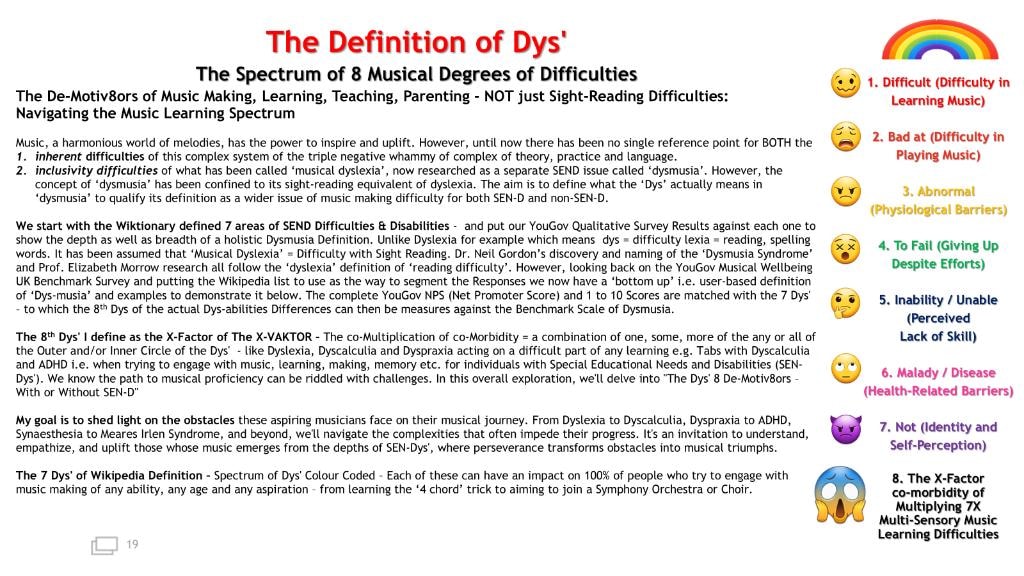
This became an exploratory stage in the research.
We looked at different meanings associated with "Dys" — difficulty, inability, failure, abnormality, health-related barriers, identity and self-perception — and then considered what happens when several difficulties or differences interact in the same person.
This was NOT our final model.
It was an important stepping stone.
Because the more we explored "Dys", the clearer something became:
DYSMUSIA WASN'T ONE DYS.
AND IT WASN'T SIMPLY MUSICAL DYSLEXIA.
The next stage was to stop trying to define Dysmusia as a single difficulty and start looking at the DIFFERENT DYS's that can surround each person's experience of making music.
17. FROM EIGHT "DYS" TO THE CIRCLE OF DYS's
The exploratory "8 Dys" work led to a breakthrough.
Instead of trying to describe Dysmusia as ONE condition or ONE difficulty, we began separating two different things.
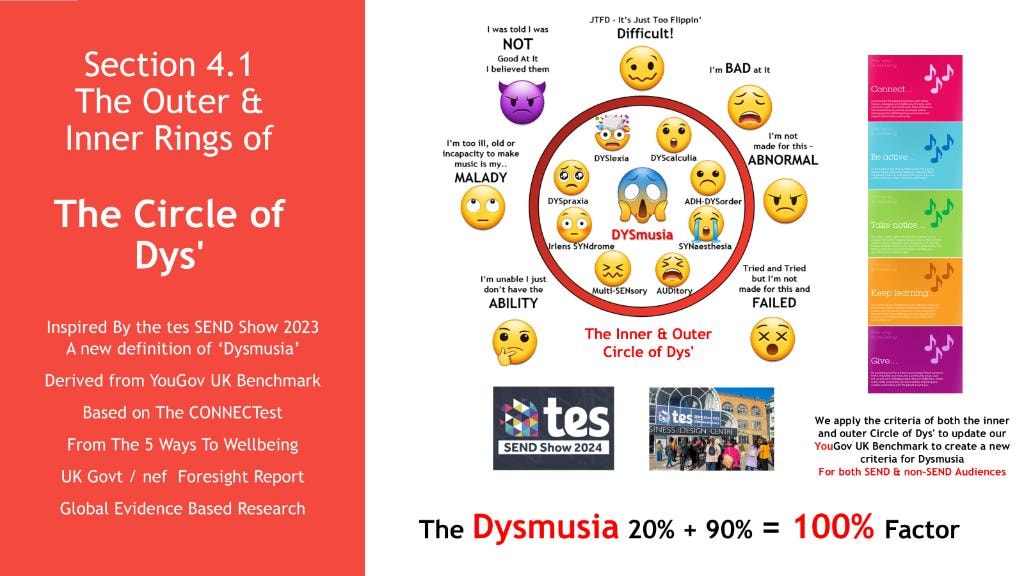
THE INNER CIRCLE
The difficulties and differences a person may bring to music making — including dyslexia, dyscalculia, dyspraxia, attention, visual-perceptual, auditory, sensory and other interacting differences.
THE OUTER CIRCLE
What the person actually experiences:
- "This is difficult."
- "I'm bad at it."
- "I'm not made for this."
- "I tried and failed."
- "I'm unable."
- "I was told I was not good at it."
And suddenly the question changed.
Not:
"DO YOU HAVE MUSICAL DYSLEXIA?"
But:
WHAT GETS BETWEEN YOU AND MAKING MUSIC — SEND OR NOT?
This became the beginning of:
THE CIRCLE OF DYS's
The model shown below records that important stage in the development of our thinking.
It is NOT the final 2026 Circle of DYS's.
Some terminology, categories and numerical formulations have developed since this original research image was created.
We preserve it here because it shows HOW the research developed.
THE CIRCLE OF DYS's — 2026
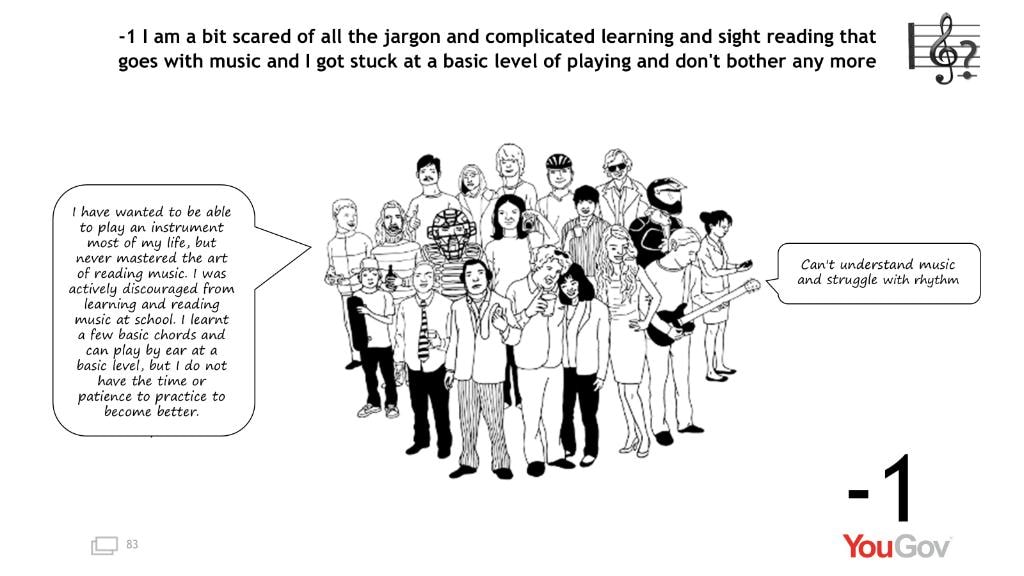
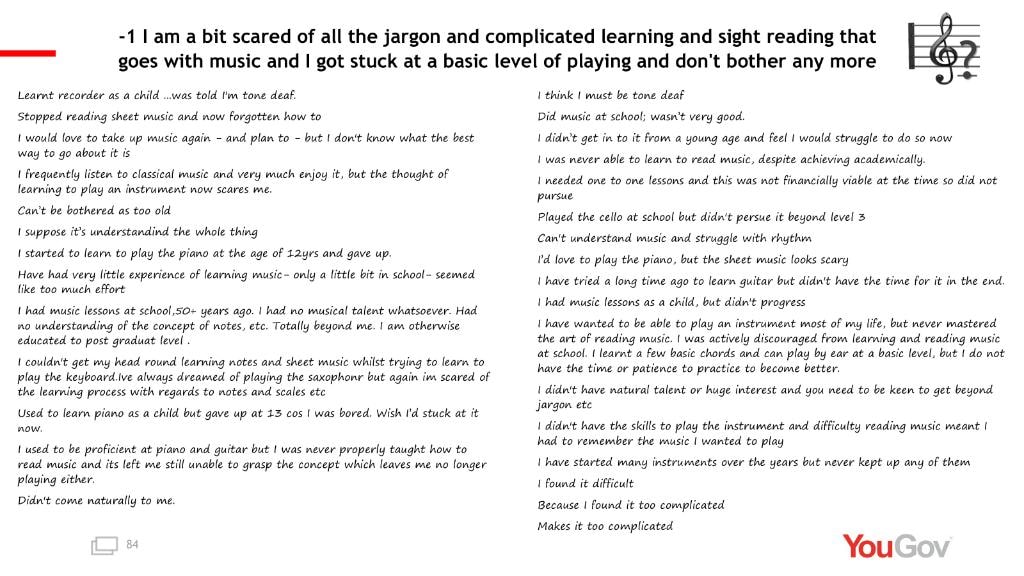
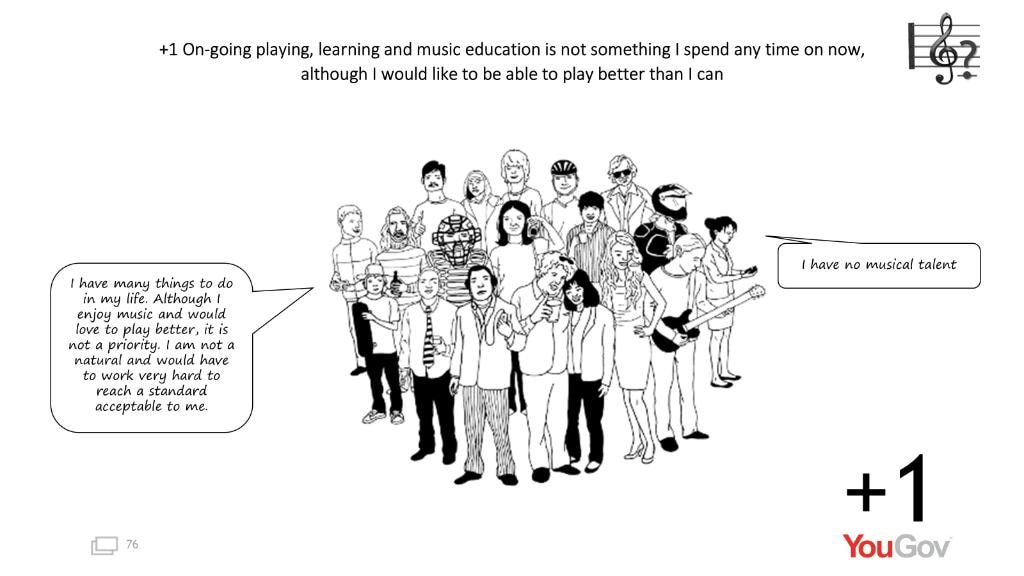
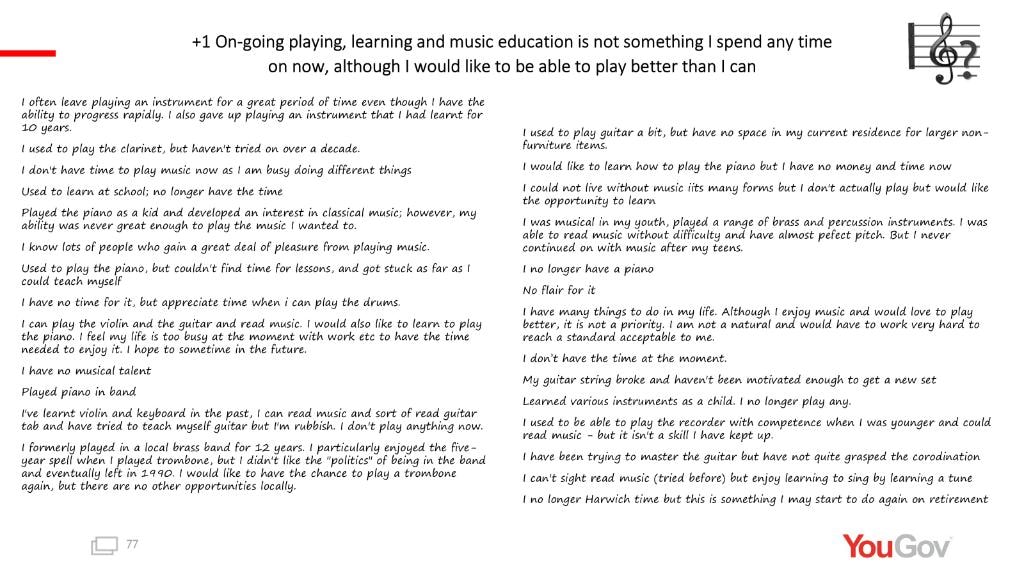
THE PEOPLE BEHIND THE PICTURE
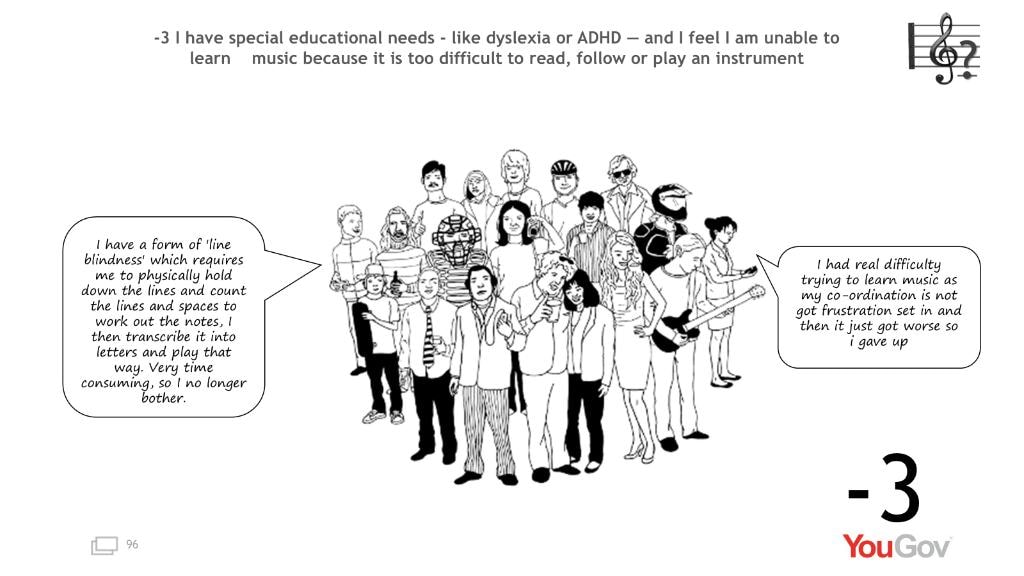
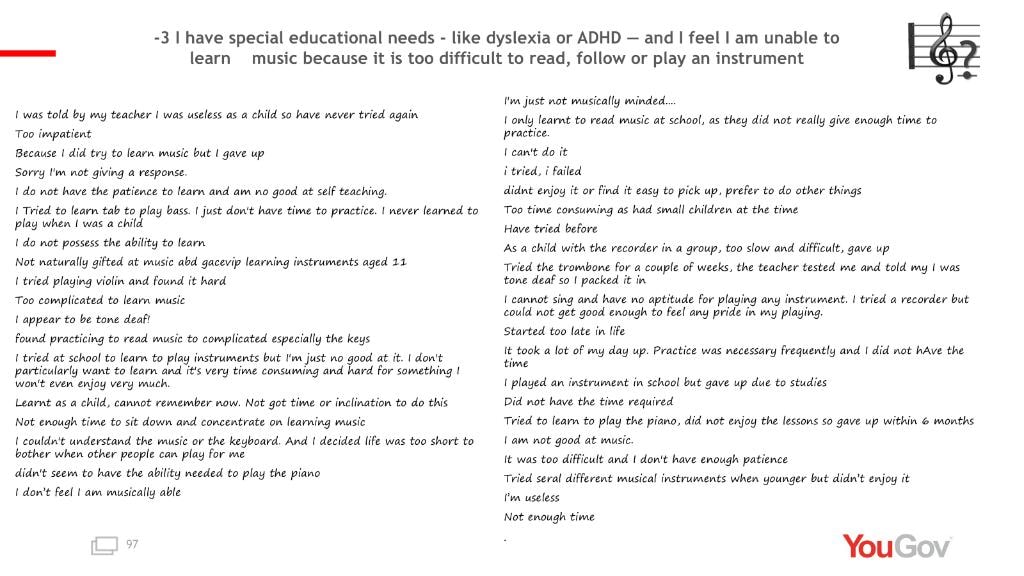
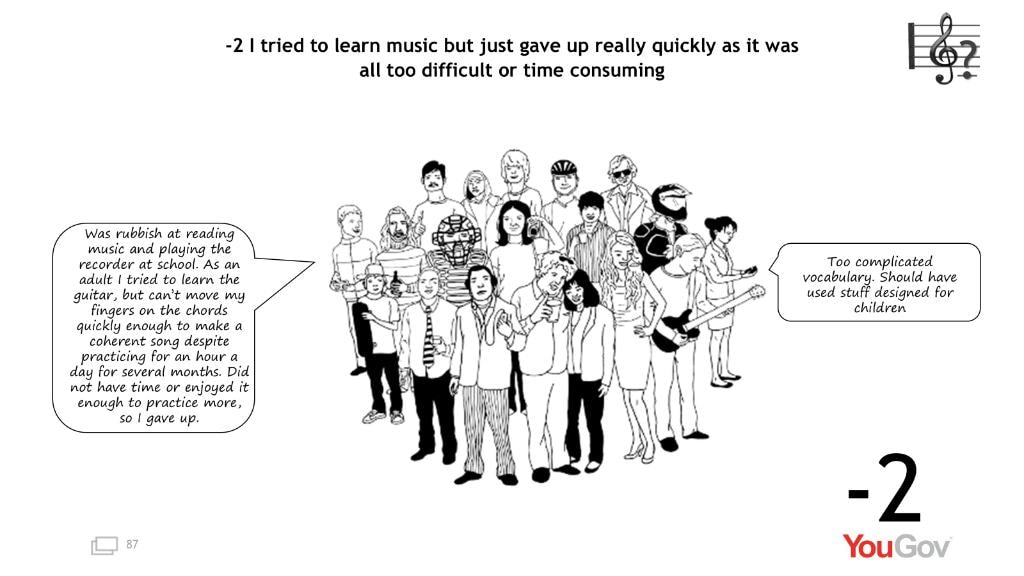
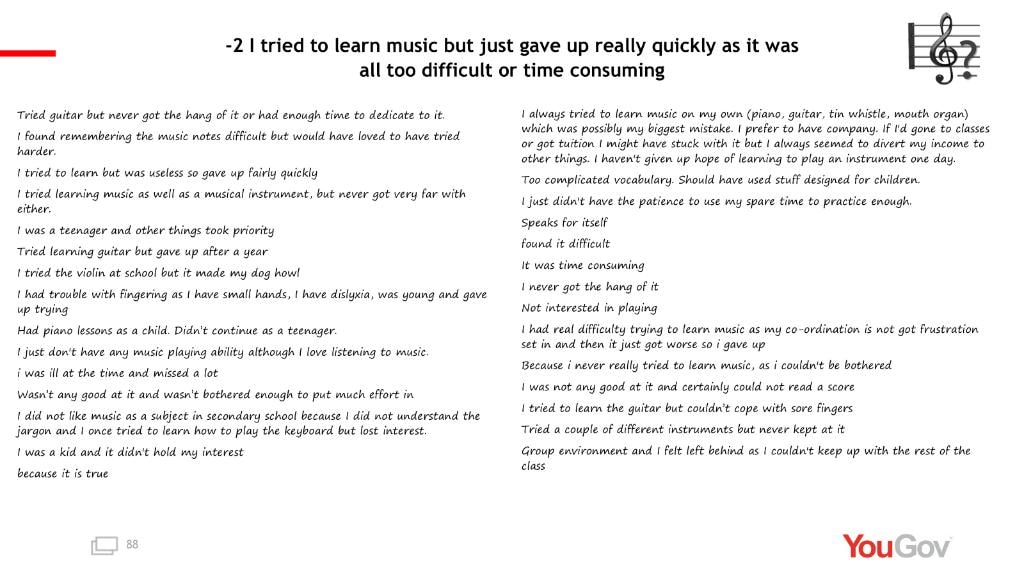
FROM -5 TO +5 THE WHOLE GAMUT OF MUSIC MAKING
QUANTITATIVE + QUALITATIVE
YouGov gave us the BIG PICTURE across 2,130 GB adults.
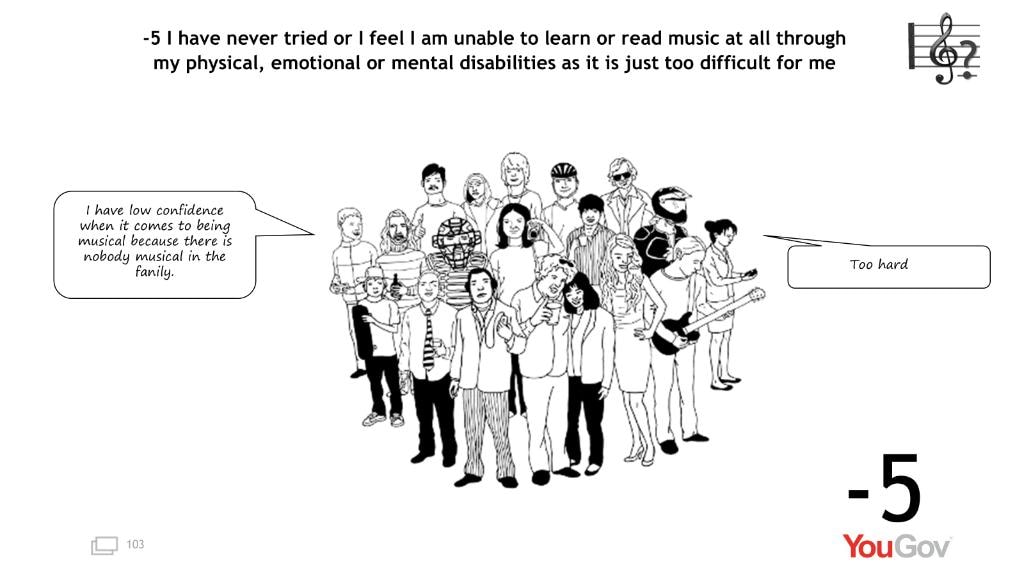
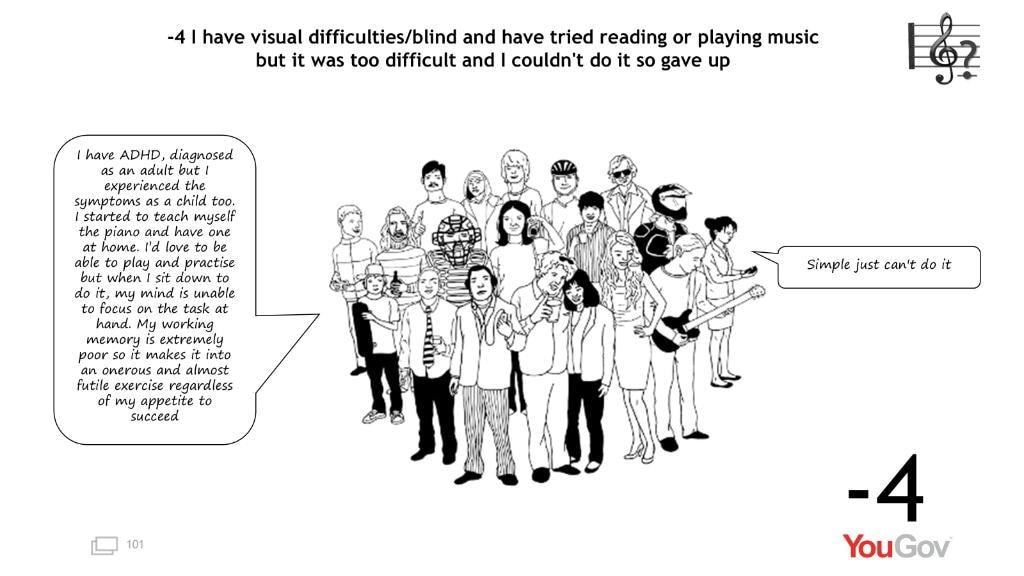
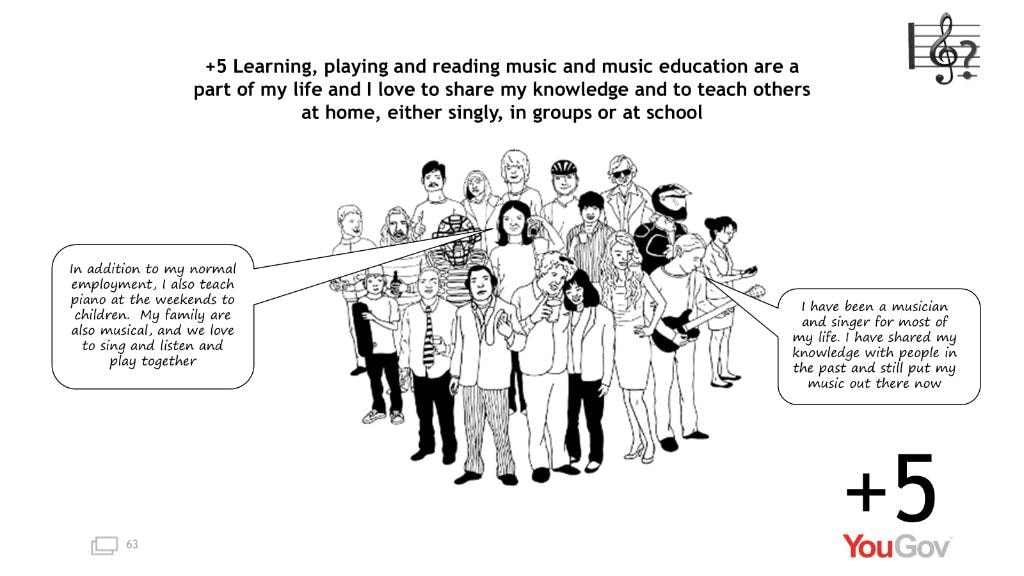
The QUANTITATIVE results tell us HOW MANY and WHERE people sit across our -5 to +5 music-making scale.
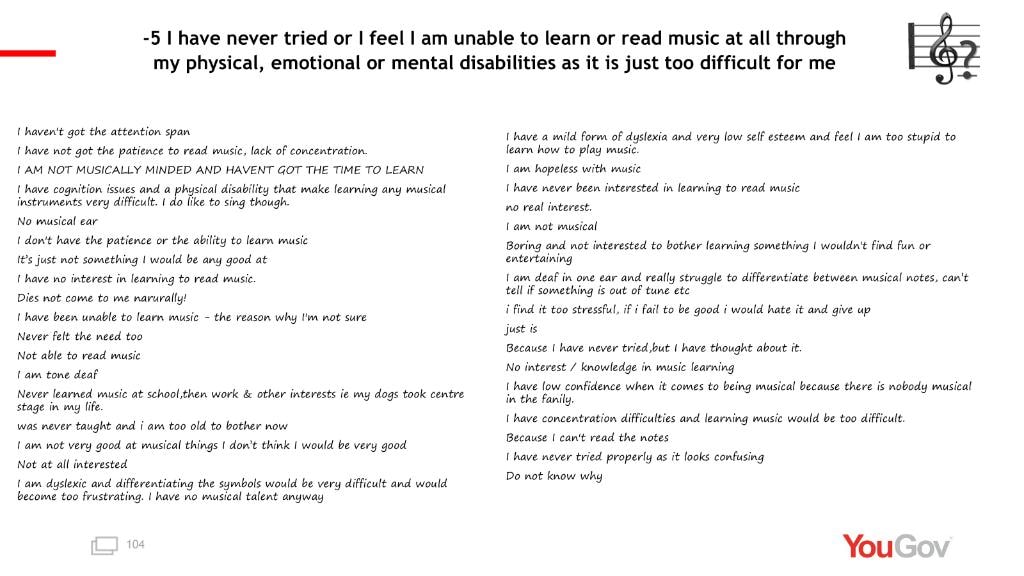
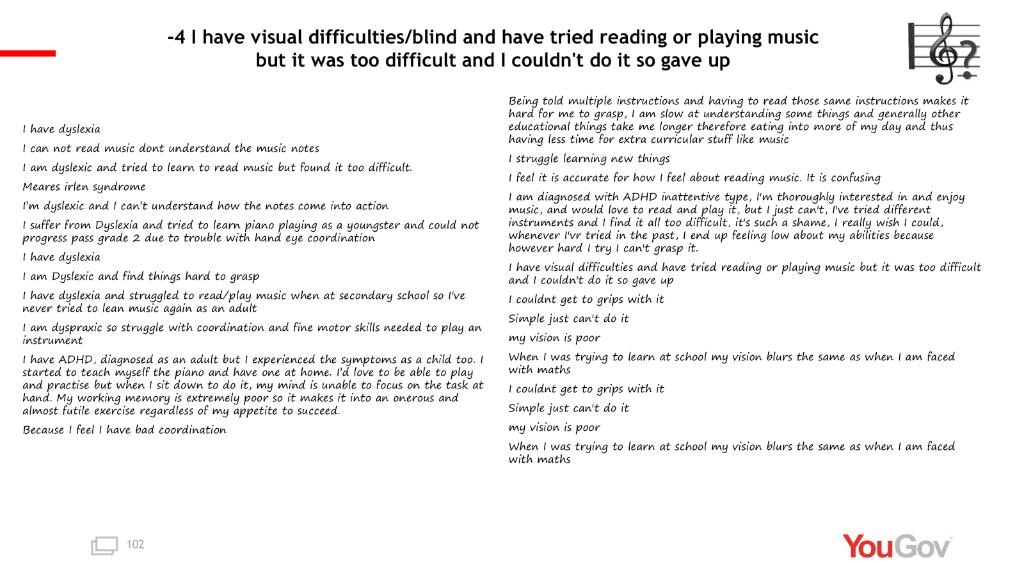
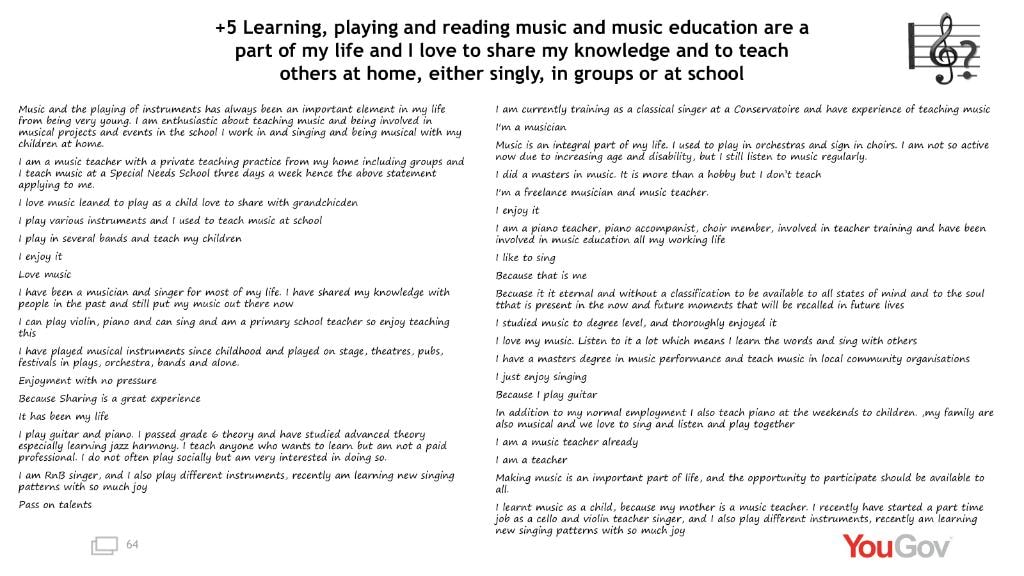
The QUALITATIVE responses add something numbers alone cannot:
THEIR OWN WORDS.
Real people.
Real experiences.
Real difficulties.
Real differences.
Real music making.
11 SCORES • -5 TO +5 • 11 PAGES
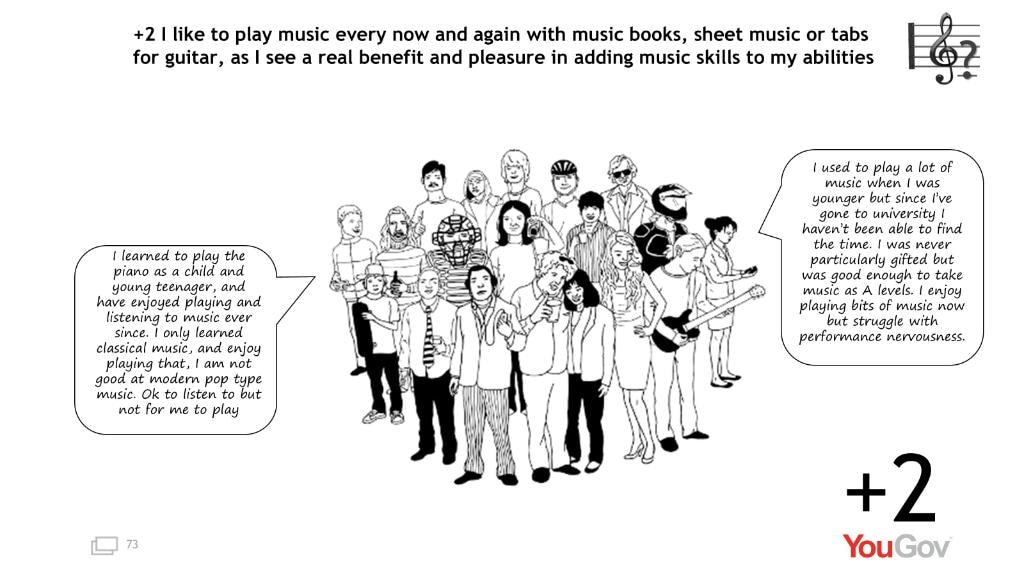
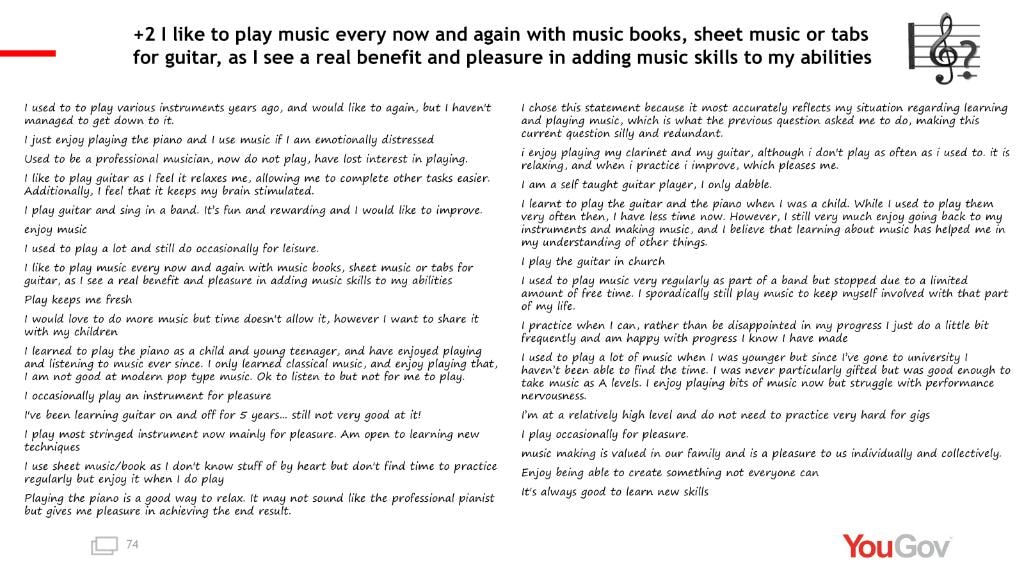
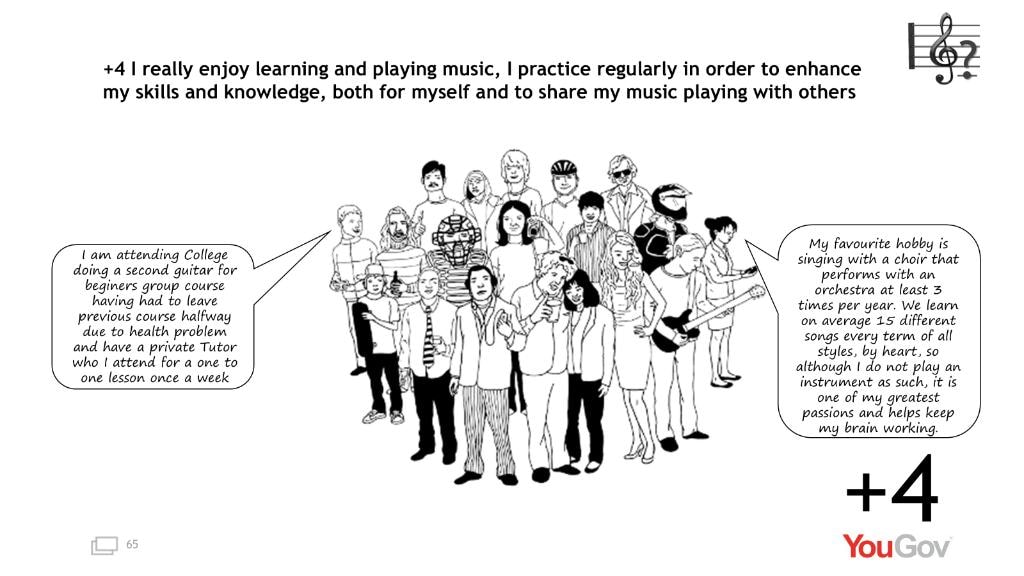
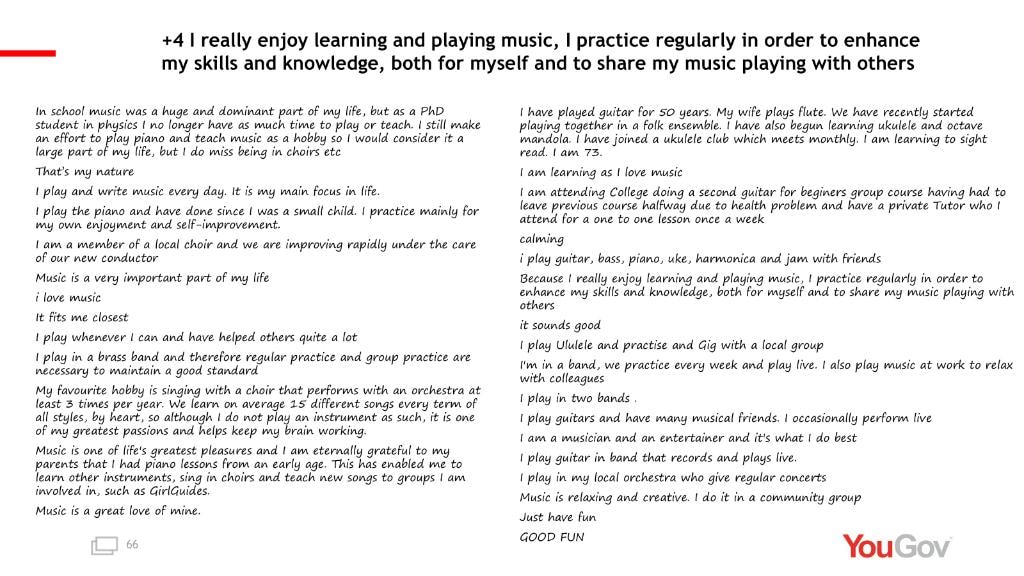
NOW HEAR WHAT THEY ACTUALLY SAID.
THANK YOU FOR READING THIS
I hope these pages have helped you see Dysmusia a little differently — and perhaps see your own, or someone else's, experience of music making differently too.
Our quest now is to establish Dysmusia as a much broader and better understood part of music making — SEND or not — and to build the Dysmusia Foundation as a place for:
Awareness • Evidence • Research • Resources • Action
We want to bring together the people who make music, tried to make music, teach it, learn it, research it, struggle with it — or gave it up altogether.
Because behind every percentage is a person.
Behind every difficulty is a different experience.
And behind every "I CAN'T" there may be another way to "I CAN".
I HOPE YOU'LL JOIN US.
Help us establish Dysmusia.
Help us build the Dysmusia Foundation.
Help us make music making more accessible to everyone.
Kevin M. Thomson
Dynamic Dysmusic Dyslexic
DYSMUSIA FOUNDATION
OUR GIVE TO MUSIC MAKING